


GCS regular project on SuperMUC-NG
Important Information!
SuperMUC-NG Phase 1 (CPU) will reach end of operation in the second half of 2026. All granted CPU budgets cannot be transferred to other systems and will expire with the end of operation of SuperMUC-NG Phase 1. Please use your budget as soon as possible.
New projects: No new applications will be accepted, independent of scientific merit.
Project extensions: Timeframe extensions are still possible to have the opportunity to finalize projects within the remaining months.
Possible steps forward are:
- If your code already supports the Ponte Vecchio GPUs on SuperMUC-NG Phase 2, you can apply for a project on SuperMUC-NG Phase 2 (test project, regular project, or large-scale project). Your proposal should demonstrate the GPU usage including performance, scaling and required GPU-h budget. Note that all existing SuperMUC-NG Phase 1 projects have a 900 GPU-h test budget on SuperMUC-NG Phase 2 to prepare the corresponding plots.
- If your code is not yet supporting the SuperMUC-NG Phase 2 hardware, you can apply for a “GCS preparatory access project", which features 7,000 GPU-h and porting support by LRZ and Intel upon request. After successful porting you can submit your proposal.
- If your code cannot be ported to GPUs, you can submit your proposal at NHR (https://www.nhr-verein.de/; limited to universities). Please contact NHR to choose a centre with available resources. Projects from national research facilities (e.g. Max Planck Society) will have to contact computing centres within their organization.
Note that SuperMUC-NG Phase 2 still has plenty available budget, but GPU usage is mandatory there. If you need consulting or have further questions, please feel free to visit us in the HPC lounge (open Zoom meeting, open for everyone, every Wednesday 2-3pm, see https://doku.lrz.de/hpc-lounge-813636379.html).
Features
- Regular projects can apply for
up to 140 K GPU-hours on SuperMUC-NG Phase 2 - Projects typically last 24 months
- Projects need to be able to use use all 4 GPUs of the compute nodes on SuperMUC-NG Phase 2.
- Rolling call: applications can be uploaded throughout the year
- Technical and scientific review process. Access to the system typically within ca. 8 weeks
If you haven't used SuperMUC-NG Phase 2 before, we strongly recommend that you apply for a GCS test project first. There, you get quick access to the system to compile and test your code, and perform scaling tests to produce scaling curves that are necessary for your application for a GCS regular project on SuperMUC-NG.
Application process
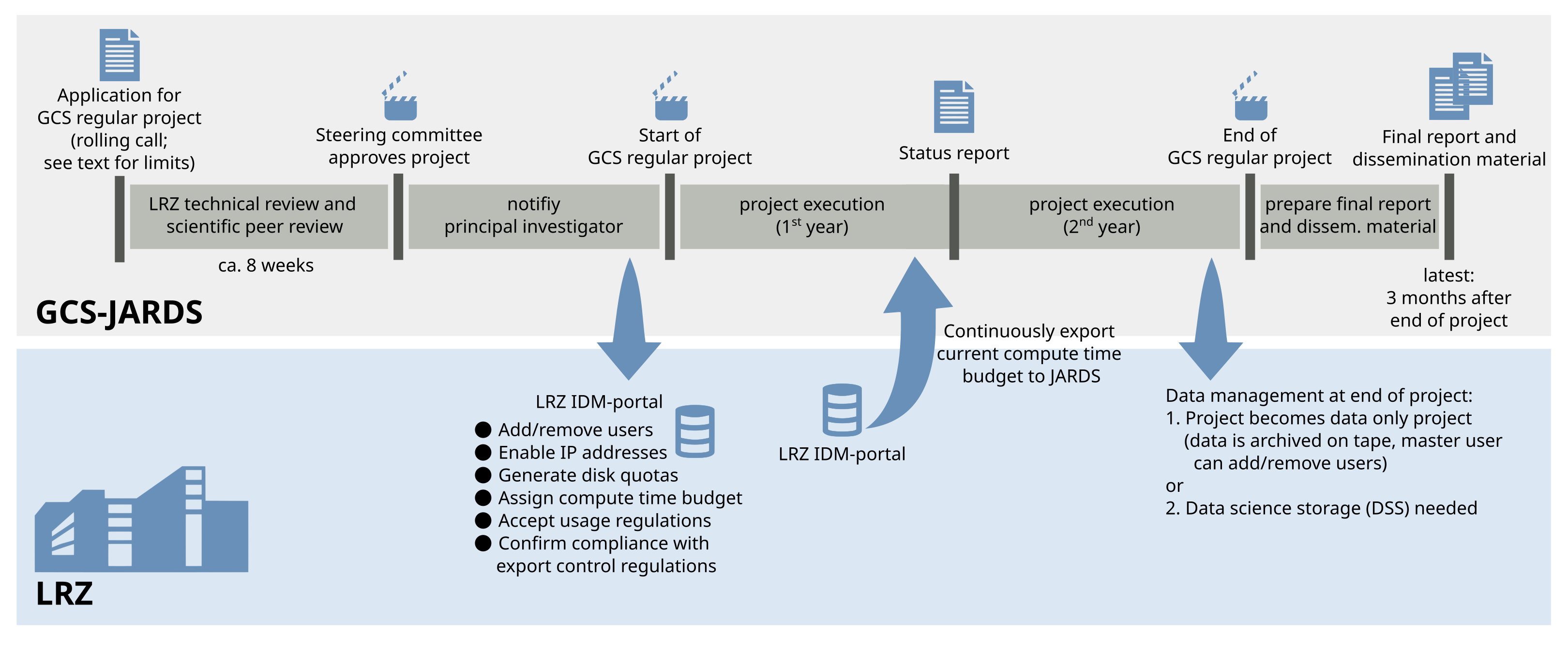
The image shows the process of applying for a GCS regular project on SuperMUC-NG. All applications for projects on SuperMUC are managed through the GCS-JARDS tool, hosted by GCS, the Gauss Centre for Supercomputing.
After finalizing your application within the GCS-JARDS website, you will be asked to print out and sign the "Principal Investigator’s Agreement for Access to HPC resources". Scan the signed document and email it to HPC-Benutzerverwaltung@lrz.de.
Once your project is approved, your SuperMUC-NG project will be created by LRZ. GCS-JARDS is used to manage the review process, collect status reports, final reports, dissemination material, and to manage project extensions.
Templates
Please follow the instructions in the application template file, available as PDF, DOCX, and TeX (.tar archive).
For details and templates for status reports, final reports, and dissemination material, see the Reporting obligations on SuperMUC-NG.
Upload your application and reports
Please log in to GCS-JARDS to upload your application.
Questions?
If you have questions, please submit a Ticket via the ServiceDesk.
You can also visit our "HPC Lounge" (virtual Zoom Meeting) every Wednesday 2-3pm. For more details and Zoom-link, visit: https://doku.lrz.de/hpc-lounge-813636379.html